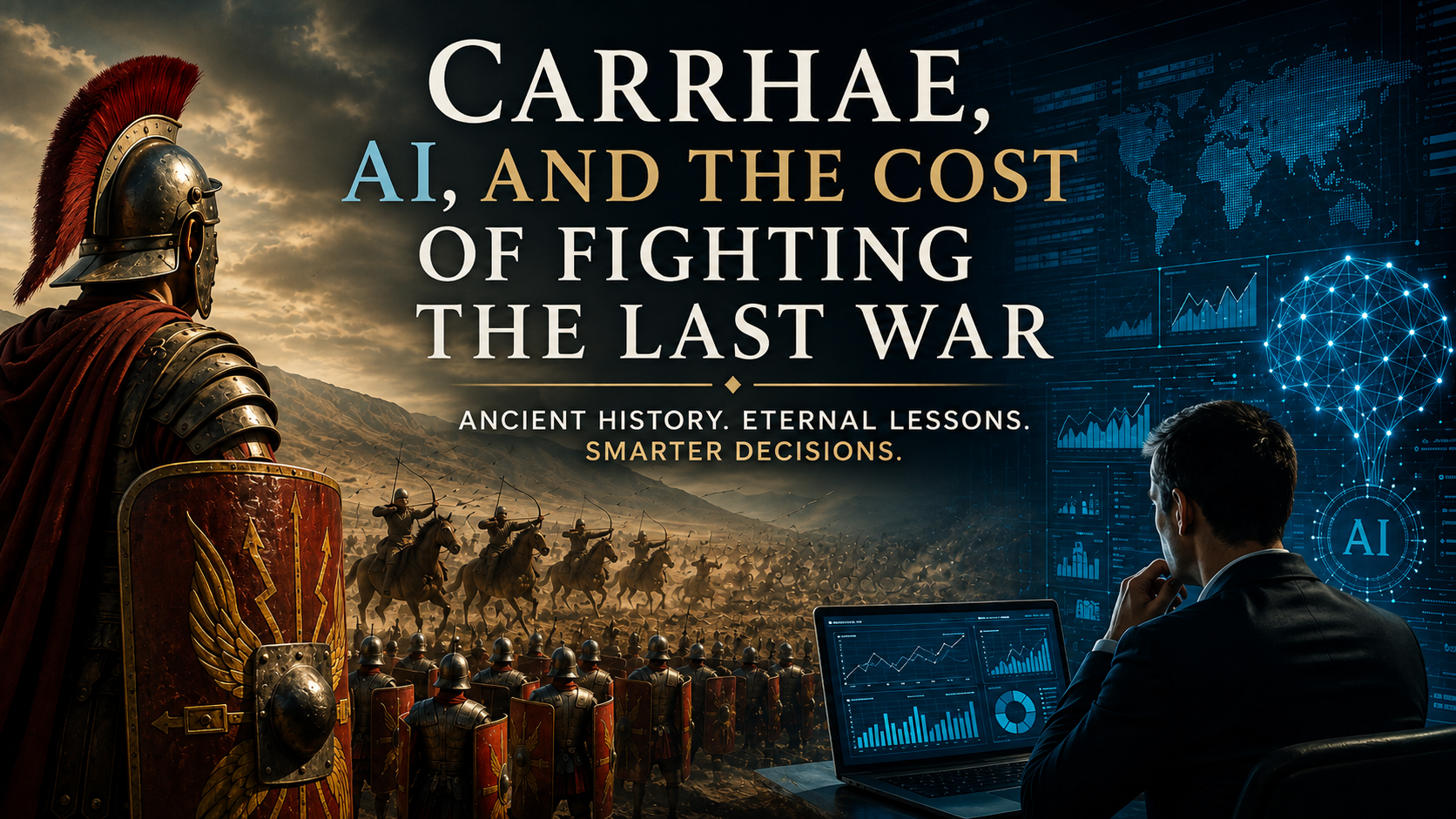
By Vinicio Donnarumma
Rome did not become Rome by being weak.
For centuries, Roman power was built on discipline, organization, engineering, logistics, and one of the most effective military systems in the ancient world: the legion. The Roman soldier was trained to stand in formation, hold the line, throw the pilum, close the distance, and decide the battle with the gladius.
It was not only a technique. It was a culture.
The Roman ideal of virtus was tied to courage, manliness, public honor, and military excellence. A soldier proved himself by facing danger directly. A commander proved himself by showing steadiness under pressure. A people proved itself by enduring hardship and imposing order where others broke.
This matters because Rome's strength was not just a weapon system. It was an identity.
And identity is powerful. It can create discipline. It can build institutions. It can make people hard to defeat.
But identity can also become a trap.
Rome Did Use Archers, But The Legion Was Built Around Something Else
The simple version of the story is tempting: Rome ignored archery, then got punished by a better technology.
That version is too clean.
Rome did use archers. During the Republic and the Empire, Roman armies employed specialist missile troops, often as allies, mercenaries, or auxiliaries. Cretan archers, Syrian archers, Balearic slingers, Numidian cavalry, and other non-legionary specialists all supported Roman campaigns.
So the point is not that Romans had never seen a bow.
The point is more subtle: the Roman legion's core doctrine was not built around long-range mounted missile warfare. Its center of gravity was disciplined heavy infantry. The legion expected to absorb pressure, maintain order, close the distance, and win through formation, courage, and close combat.
That system worked so well, for so long, that it shaped how Rome understood war itself.
Then came Carrhae.
Carrhae: When The Battlefield Changed
In 53 BCE, Marcus Licinius Crassus led a Roman army into Mesopotamia against the Parthian Empire.
The numbers vary by source, but the standard picture is roughly this: Crassus crossed the Euphrates with seven legions, around 34,000 heavy infantry, plus cavalry and light troops, for a total force of about 40,000 to 42,000 men.
Opposing him was Surena, the Parthian commander, with a much smaller force: about 1,000 heavily armored cavalry and around 9,000 horse archers.
On paper, Rome had mass.
Parthia had mobility.
The Romans expected that the enemy would eventually run out of arrows or be forced into close combat. That expectation was fatal. Surena had prepared camels loaded with spare arrows, allowing the horse archers to keep firing far longer than the Romans anticipated.
The Parthians did not need to break the legion in the traditional way. They did not need to stand still and trade blows. They surrounded, harassed, withdrew, resupplied, and kept attacking from range.
When Roman troops tried to pursue, the horse archers rode away while continuing to shoot. When the Romans stayed in formation, they became dense targets. When they tried to close the distance, the distance moved.
Roman discipline was real. Roman courage was real.
It was not enough.
The defeat at Carrhae became one of the great disasters of Roman military history. Crassus was killed. Thousands of Roman soldiers died or were captured. The Parthians exposed a painful truth: an army can be brave, experienced, and disciplined, and still be unprepared for a different kind of battlefield.
The Dangerous Comfort Of Being Good
This is the part that feels modern.
Most people do not reject new tools because they are lazy. Often, they reject them because they are already competent.
They know their craft. They trust their process. They have built a career on certain skills, certain routines, certain instincts. Their confidence has evidence behind it.
That is exactly why change is hard.
If you are bad at something, learning a new method is easy to justify. If you are good, the new method can feel like an insult.
Why should I change?
Why should I learn this?
I already know how to do my job.
That is the dangerous comfort of competence. It turns past success into an argument against adaptation.
The Roman legion was not obsolete. Heavy infantry still mattered. Discipline still mattered. Courage still mattered. But Carrhae showed that those strengths had limits when the operating environment changed.
The same is true now with AI.
AI does not make experience worthless. It does not replace judgment. It does not remove the need for discipline, skepticism, or responsibility.
But it changes the range and speed of analysis.
It changes how quickly information can be organized.
It changes how many scenarios can be explored.
It changes the workflow between question, data, hypothesis, test, and decision.
The professional who refuses to learn AI is not protecting craftsmanship. He may simply be choosing to fight the next battle with the assumptions of the last one.
AI Is Not The Warrior. It Is The Bow.
There is a bad way to talk about AI: as if it were magic.
It is not.
AI can be incomplete. It can be wrong. It can hallucinate. It can amplify bad inputs and create false confidence. Anyone who treats it as an oracle is making a different version of the same mistake: confusing the tool with judgment.
But there is also a bad way to reject AI: pretending it is just a toy because it does not replace human expertise.
That misses the point.
The bow did not replace the warrior. It changed what a warrior could do from a distance.
Mounted archery did not eliminate courage. It changed the geometry of courage.
AI does not eliminate analysis. It changes the speed, structure, and reach of analysis.
For investors, this distinction matters. The problem is not that people lack opinions. The market is full of opinions. The problem is turning information into a repeatable research process: comparing securities, checking assumptions, testing strategies, reviewing portfolios, and separating signal from noise.
That is where modern tools can help.
Not by telling anyone what to buy.
Not by promising certainty.
Not by pretending the future can be known.
But by helping users organize research, examine data, test ideas, and make decisions with more structure.
The Real Lesson
The lesson of Carrhae is not "old bad, new good."
Rome itself was one of history's great learning machines. Roman armies copied, adapted, absorbed, reorganized, and improved. That is one reason Rome survived so many disasters.
The better lesson is this:
When the battlefield changes, strength must adapt or it becomes rigidity.
Experience is still valuable.
Discipline is still valuable.
Judgment is still valuable.
But none of them should become excuses for refusing to learn.
In every era, there are people who look at a new tool and see only a threat to the identity they already have. And there are people who look at the same tool and ask a better question:
What does this make possible that was not possible before?
That question is where adaptation begins.
Rome learned it through blood and dust on the plains near Carrhae.
We have the easier option.
We can learn before the battlefield forces us to.
TyBuff Angle
TyBuff is built around that same principle: better tools should not remove the user's responsibility. They should make analysis more structured.
AI should not replace the investor's judgment. It should help the investor ask better questions, compare more clearly, test assumptions more carefully, and stay in control of the final decision.
The future does not reward people simply for using new technology.
It rewards people who learn how to think with it.
Source Notes
- Encyclopaedia Iranica, "Carrhae": https://www.iranicaonline.org/articles/carrhae-harran-town-in-mesopotamia-where-in-may-53-b/
- Plutarch, "Life of Crassus": https://penelope.uchicago.edu/Thayer/E/Roman/Texts/Plutarch/Lives/Crassus%2A.html
- World History Encyclopedia, "Roman Armor & Weapons": https://www.worldhistory.org/article/1692/roman-armor--weapons/
- Perseus / Dictionary of Greek and Roman Antiquities, "Exercitus": https://www.perseus.tufts.edu/hopper/text?doc=Perseus%3Atext%3A1999.04.0063%3Aentry%3Dexercitus-cn
- Cambridge University Press, A. D. Lee, "Military Service and Courage": https://www.cambridge.org/core/books/warfare-in-the-roman-world/military-service-and-courage/1E4091F2A9B7C026649ED3A9143E01D7