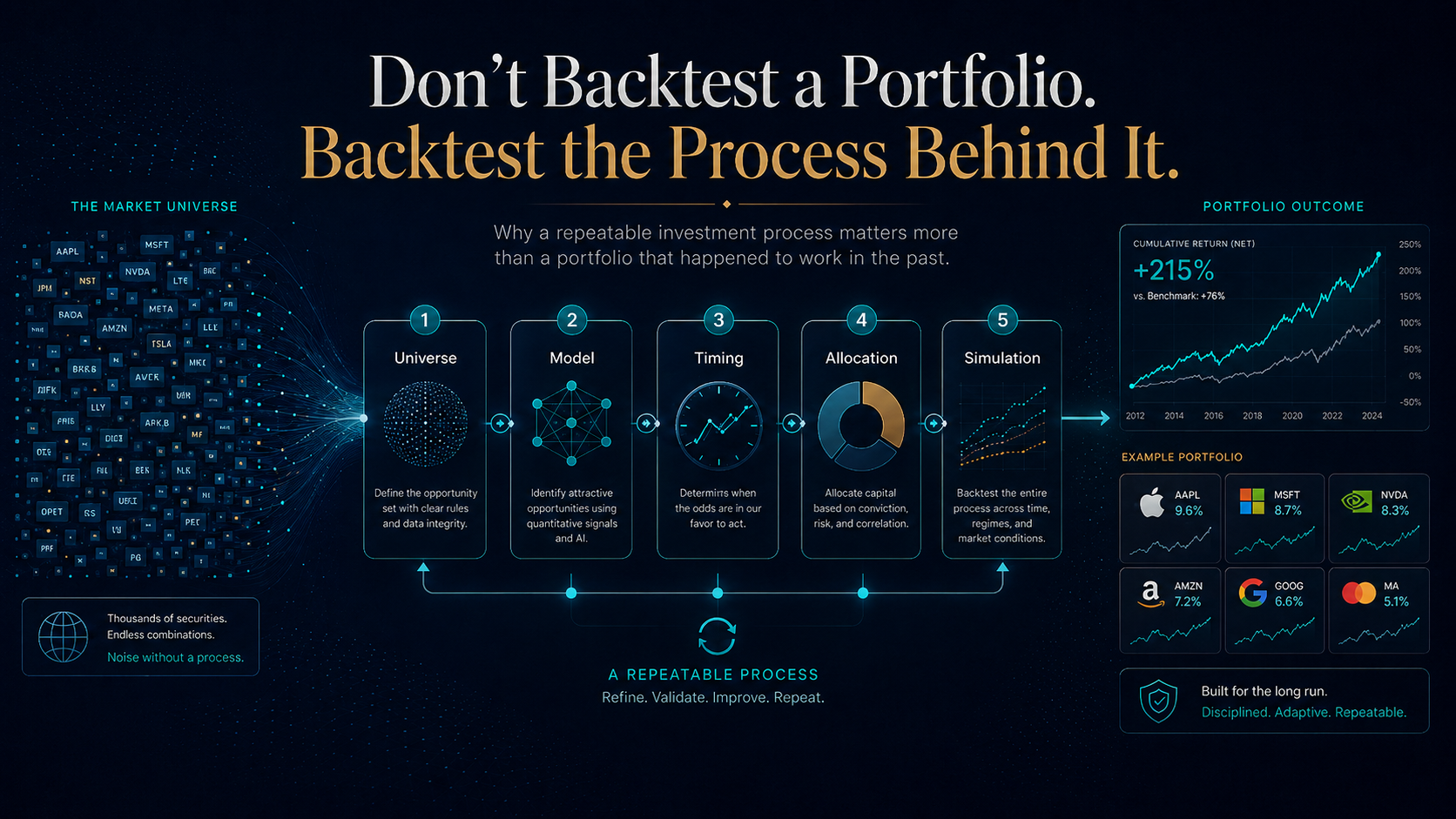
Why a repeatable investment process matters more than a portfolio that happened to work in the past.
Backtesting has become one of the most common tools in modern investment research.
Choose a group of securities. Select a historical period. Define a rebalancing schedule. Run the simulation. Compare the result with a benchmark.
The output is usually a chart.
And if that chart looks good, it can be tempting to conclude that the strategy was good too.
But there is a deeper question:
What exactly did the backtest test?
A portfolio is only the final result of a series of decisions. Before a security ever appears inside a portfolio, something has to determine whether it was eligible, how it was evaluated, when that evaluation occurred, how much capital could be allocated to it, and what would cause the portfolio to change later.
That entire sequence is the investment process.
At TyBuff, we believe that is what deserves to be tested.
A portfolio is an output, not a strategy
Imagine a backtest containing ten stocks.
The result might tell us how those ten securities would have performed over the last five or ten years.
But why were those ten stocks selected?
Were they chosen because they are attractive today?
Were they among today's largest companies?
Did we already know they survived the historical period?
Would the same information have been available to an investor at the beginning of the simulation?
These questions matter because a successful historical basket can sometimes tell us more about what we know today than about a process that could realistically have been followed at the time.
A repeatable investment strategy should instead begin with rules.
For example:
- What securities are eligible for consideration?
- Can that eligible universe change through time?
- What information is used to rank or filter those securities?
- How are individual instruments evaluated?
- How many positions can be held simultaneously?
- When does the strategy reevaluate the market?
- How is available capital allocated?
- When is the underlying investment universe reconstructed?
Only after those questions are answered does a portfolio emerge.
The portfolio is the consequence of the process.
Step 1: Define what the strategy is allowed to consider
Every strategy begins with an investment universe.
Sometimes that universe is intentionally fixed. An investor may want to analyze a specific collection of stocks, ETFs or other instruments.
But many real investment processes are dynamic.
An investor may instead want to consider securities that satisfy particular characteristics at each point in time.
For example:
- the strongest securities by momentum;
- companies above a chosen fundamental threshold;
- securities ranked by Sharpe ratio;
- the strongest instruments according to a proprietary market score;
- instruments passing a combination of Market Explorer filters.
That creates an important difference.
A conventional backtest may begin with:
“Test these 20 stocks.”
A dynamic strategy can instead begin with:
“At each evaluation date, determine which securities qualify under these rules, rank them, and build the eligible universe from the information available at that time.”
The list of securities is no longer the strategy.
The rule that creates the list becomes part of the strategy.
A dynamic universe changes the question
Consider two hypothetical approaches.
Approach A
Today, select 20 successful companies and test how they would have performed over the previous eight years.
Approach B
At every historical rebalance date, reconstruct the eligible market using the chosen rules and select the securities that would have qualified at that moment.
The two tests may look similar on the surface.
They are not.
The second approach asks a much more difficult—and much more useful—question:
Could the same process have been applied without knowing what happened next?
This is why point-in-time data and the treatment of securities that later disappeared from the market are so important in serious historical testing.
A backtest should not quietly benefit from information that an investor could not have known at the time.
Step 2: Separate market selection from model evaluation
Once an investment universe has been defined, another question begins:
How should the eligible instruments be evaluated?
At TyBuff, these are separate layers.
Market Explorer can help define or rank the universe.
The TyBuff analytical models can then evaluate the instruments inside that universe using a consistent framework.
This distinction matters.
A ranking rule might answer:
“Which securities currently have the strongest momentum?”
The analytical model addresses a different question:
“Given the instruments that are eligible, what does the model currently identify in their behavior and conditions?”
The universe determines what can enter the analysis.
The model determines how those instruments are evaluated.
Keeping those functions separate creates a much more flexible framework.
The user can change the universe without changing the underlying model.
Or keep the same universe and test different portfolio-construction priorities.
The result is not one predefined strategy.
It is a controlled environment for examining how different investment hypotheses behave.
Machine learning should be part of the process—not a black box replacing it
Artificial intelligence is now everywhere in investment software.
It is increasingly easy to ask an AI system:
“What stocks should I buy?”
The system may produce a confident and sophisticated answer.
But a convincing explanation is not the same thing as a reproducible investment methodology.
TyBuff takes a different approach.
Its analytical models are part of a broader structured process.
The investor still defines important constraints and decisions:
- the eligible investment universe;
- the number of simultaneous positions;
- the evaluation schedule;
- the allocation methodology;
- the ranking or filtering criteria;
- the frequency with which the universe itself changes.
The models operate inside those rules.
That makes the system configurable without turning every decision over to a generative AI model.
And it also creates an important separation:
Analytical engines calculate. Generative AI can explain.
An AI assistant may eventually make the process easier to configure and understand, but the underlying portfolio results should continue to come from reproducible analytical engines rather than from an LLM improvising an answer.
Step 3: Portfolio construction is part of the strategy
Suppose two investors identify exactly the same ten securities.
They can still end up with very different results.
One may hold all ten.
Another may allow only five simultaneous positions.
One may allocate capital evenly.
Another may prioritize lower-risk opportunities.
Another may prioritize momentum.
Another may focus on resilience.
This is why portfolio construction cannot be treated as an afterthought.
In TyBuff, users can define parameters such as:
- maximum simultaneous positions;
- initial capital;
- reinvestment rules;
- portfolio priority;
- evaluation frequency;
- strategy timing.
Priority methodologies can then determine how available capital is assigned when multiple eligible opportunities exist.
The important point is not simply that there are more settings.
It is that every setting corresponds to a real investment decision.
A useful way to think about the process is through four questions:
What can enter?
The investment universe and its filters.
When does the strategy act?
The evaluation and rebalance schedule.
How many positions can it hold?
Portfolio-capacity and exposure rules.
How is capital prioritized?
The portfolio-construction methodology.
Together, those decisions define behavior.
Step 4: Timing deserves its own layer
Investment strategies are not only about what to own.
They are also about when decisions are made.
A strategy might reconstruct its investment universe quarterly but evaluate the instruments every month.
Another might update the universe monthly but only make portfolio decisions at specific scheduled intervals.
Another might intentionally operate only during selected periods.
These distinctions can materially change results.
That is why TyBuff separates elements such as universe reconstruction, strategy evaluation and portfolio timing rather than treating every process as a simple fixed rebalance.
The objective is to model the process as explicitly as possible.
Because if timing rules matter in the real strategy, they should also matter in the historical simulation.
Step 5: Test the complete process through time
Once the universe, model, portfolio logic and timing have been defined, the backtest becomes much more meaningful.
Instead of asking:
“How did these securities perform?”
we can ask:
“How would this complete set of rules have behaved through different historical environments?”
That is a fundamentally different question.
The process can be reconstructed period by period:
- Determine the eligible universe using the information available at that point.
- Apply the selected ranking or filtering methodology.
- Evaluate the instruments through the analytical model.
- Apply the portfolio constraints.
- Allocate capital according to the selected priority.
- Record the resulting hypothetical portfolio.
- Repeat the same process at the next scheduled evaluation.
The result is not simply a historical basket.
It is a simulation of a decision process.
But a good backtest is not automatically a good strategy
More flexibility creates another danger.
If investors repeatedly change parameters until they discover the most attractive historical result, the backtest can become a tool for fitting the past rather than learning from it.
That is not the purpose of customization.
Changing:
- the number of positions;
- the ranking size;
- the rebalance frequency;
- the investment universe;
- the evaluation schedule;
can generate very different historical outcomes.
The objective should not be:
“Which combination produces the highest historical return?”
A more useful question is:
“Does the underlying idea remain coherent when reasonable assumptions change?”
For example:
Does a strategy still behave sensibly with 10 positions instead of 12?
Does quarterly evaluation produce a radically different conclusion from monthly evaluation?
Does performance disappear if the universe contains the top 30 instruments instead of the top 20?
Does the process work only during one specific market environment?
These questions help distinguish an interesting historical result from a potentially robust methodology.
This is also why areas such as parameter sensitivity, transaction-cost assumptions, walk-forward analysis and out-of-sample testing are natural extensions of serious strategy research.
The goal should be to challenge a strategy, not simply optimize its chart.
Backtesting should not be the end of the process
Another limitation of traditional backtesting is what happens after the simulation is complete.
The investor obtains a historical result.
Then what?
If the rules were genuinely intended to describe a repeatable process, those same rules should continue to exist tomorrow.
This creates an important distinction between a backtest and a saved strategy.
A saved TyBuff strategy can preserve the methodology used to create it:
- the universe;
- the rankings;
- the model;
- the timing;
- the position limits;
- the allocation methodology.
As new market data becomes available, the same process can continue to be evaluated.
This creates a natural progression:
Build → Test → Save → Follow → Compare → Refine
The historical simulation becomes the beginning of an analytical process rather than its conclusion.
From static portfolios to dynamic investment processes
Markets change.
Leadership changes.
Volatility changes.
Companies disappear.
New instruments become relevant.
A static list of securities cannot capture all of that.
A dynamic investment process can.
That does not mean dynamic strategies are automatically superior.
It means they allow investors to ask a different kind of question.
Instead of:
“Which securities would have performed best?”
the question becomes:
“What repeatable rules could have identified and managed opportunities using only the information available at each point in time?”
That is the problem TyBuff is designed to explore.
The role of TyBuff
TyBuff does not exist to tell investors which security they should buy.
It does not execute trades or manage client assets.
It is an analytical environment designed for self-directed investors who want to examine investment ideas as structured, reproducible processes.
Its core can be summarized as five connected layers:
Universe
Choose the securities that can be considered—or define rules that allow the universe itself to evolve.
Model
Apply a consistent analytical framework to the eligible instruments.
Timing
Determine when the market, model and portfolio are evaluated.
Allocation
Define how many positions can be held and how available capital is prioritized.
Simulation
Reconstruct how that complete process would have behaved historically and continue following the same rules going forward.
Universe → Model → Timing → Allocation → Simulation
Each layer matters.
And because the layers remain distinct, investors can study not only the final result but also the assumptions that produced it.
The real question behind every backtest
When looking at an impressive historical result, it is worth asking:
Could I actually have followed this process at the time?
If the answer depends on today's stock list, hindsight, hidden assumptions or rules that cannot be reproduced, the chart may be less informative than it appears.
A better backtest begins by defining the process first.
What could have been selected?
What information was available?
How would it have been evaluated?
When would decisions have occurred?
How would capital have been allocated?
And could exactly the same rules continue operating after the historical test ends?
Because ultimately:
A portfolio is only a snapshot. A process is what can be repeated.
And if an investment idea is meant to survive beyond a historical chart, the process behind it is what deserves to be tested.
TyBuff is analytical software for self-directed investment research. It does not provide personalized investment advice, execute trades, hold client funds or recommend that users buy or sell specific securities. Historical simulations and model outputs are for analytical and educational purposes and do not predict future results.