By Vinicio Donnarumma
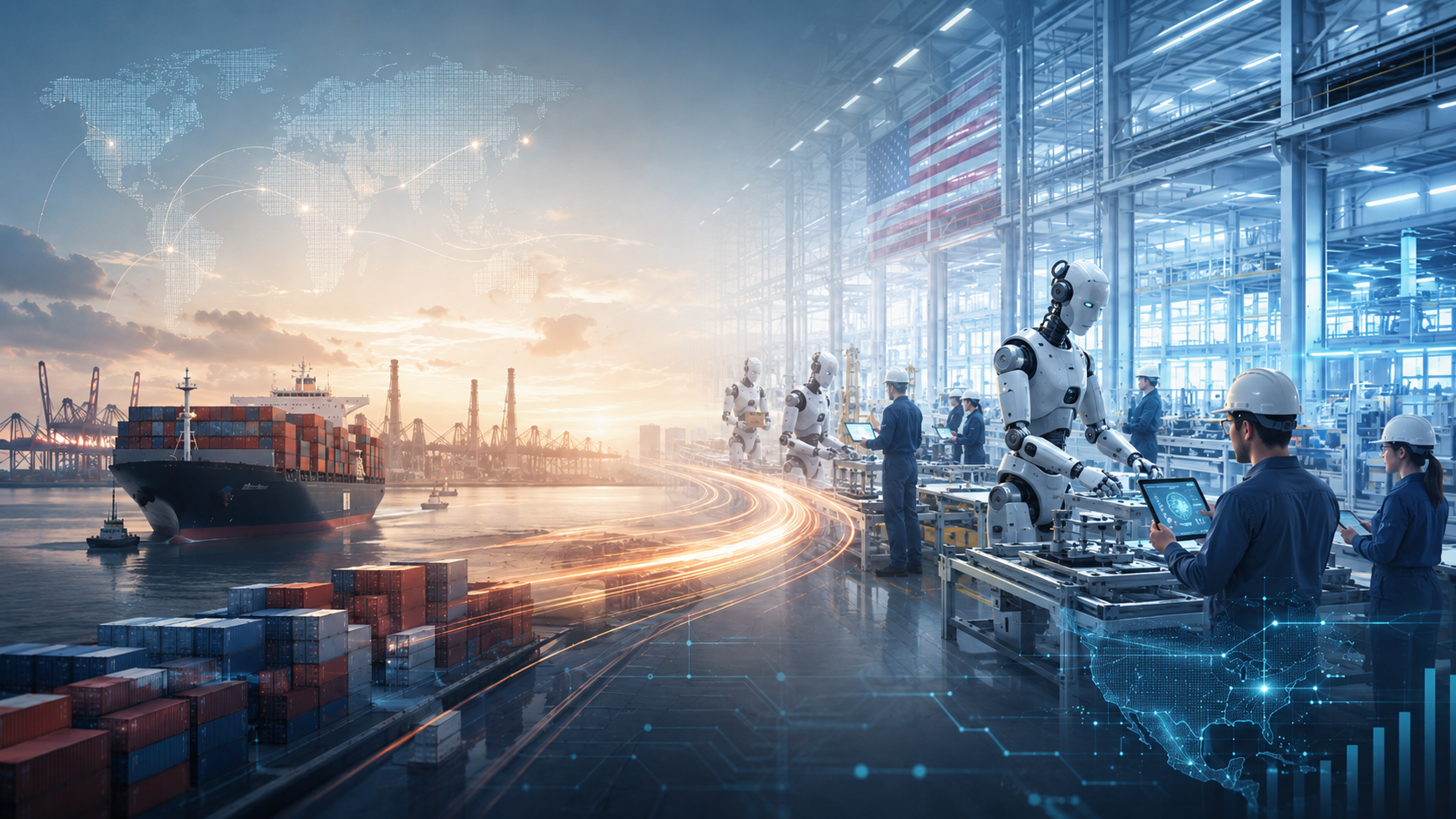
Automation could weaken the labor-cost advantage that drove decades of offshoring, reshaping manufacturing, global trade and the economic competition between the West and China.
Updated August 17, 2026.
For years, the debate around artificial intelligence and robotics has followed a familiar storyline: machines will become more capable, companies will need fewer workers, and millions of jobs may eventually disappear.
That concern is legitimate. AI can automate cognitive tasks, while robotics can automate an expanding range of physical ones. Together, they may transform occupations that were previously considered protected from technological disruption.
But this is only one side of the story.
The same technologies that could replace certain workers may also weaken one of the principal reasons companies moved production abroad in the first place: the availability of much cheaper labor.
If labor becomes a smaller component of manufacturing costs, producing goods thousands of miles away may no longer be as attractive. Companies could instead place automated factories closer to their customers, engineers and primary markets.
Robotics might therefore do something apparently contradictory: reduce the number of workers required inside each factory while increasing the number of factories that advanced economies can competitively operate.
The robots may not bring every old job home. But they could help bring production, investment and industrial capacity home.
Why manufacturing moved abroad
Over several decades, companies in the United States and Europe relocated or outsourced large portions of their manufacturing to countries where wages were significantly lower.
The economic calculation was relatively straightforward. Even after accounting for shipping, customs, longer delivery times and more complicated supply chains, the savings generated by lower labor costs could be substantial.
This process gave consumers access to less expensive products and allowed businesses to improve margins. It also helped create enormous manufacturing ecosystems in China and other emerging economies.
The decision to offshore, however, was never based exclusively on wages. China developed extensive supplier networks, modern ports, specialized industrial clusters, manufacturing expertise and the ability to scale production rapidly. Once those ecosystems were established, they became difficult to reproduce elsewhere.
Nevertheless, labor-cost differences remained an important part of the equation.
Robotics changes that equation.
What happens when labor is no longer the decisive cost?
Imagine two factories producing the same product.
The first is located abroad and relies heavily on manual labor. The second is located close to the final customer but uses robots, machine vision, automated quality control and AI-supported production planning.
The domestic factory may still face higher wages, property costs and regulatory expenses. But if it needs far fewer labor hours per unit produced, the wage difference between the two countries becomes less important.
At the same time, the domestic facility may benefit from shorter delivery times, lower inventory requirements, faster product changes, better coordination with engineers, more direct quality control and reduced exposure to international disruptions.
Research from the OECD has long identified this possibility. As robotic manufacturing becomes less expensive and offshoring becomes more complicated, automation can narrow the production-cost difference between advanced and emerging economies. The OECD has also noted that highly automated activities are among those most likely to become economically attractive for reshoring.
This does not mean every product will suddenly be manufactured domestically. Labor-intensive goods with thin margins may continue to come from lower-cost countries, while access to raw materials and established supplier networks will remain decisive in many industries.
But robotics could progressively move the economic boundary. Products that were previously too expensive to manufacture in the United States or Europe may become viable when automation is considered alongside transportation, tariffs, inventory, geopolitical risk and time to market.
Factories can return without the old jobs returning
This is the most important qualification.
Reshoring production is not necessarily the same as reshoring employment.
A traditional factory that once required several thousand workers might return as a modern facility employing only a fraction of that number. Robots could perform assembly, packaging, movement, inspection and repetitive processing, while a smaller workforce supervises the systems and handles more complex tasks.
Economists at the Federal Reserve Bank of San Francisco have found that greater trade uncertainty can encourage both reshoring and automation. However, the employment effect may remain limited because automation creates some jobs while replacing others. Productivity can rise without producing a comparable increase in total employment.
That distinction matters.
It would be misleading to promise that robotics will recreate the same mass-employment factories that existed in the twentieth century. The manufacturing facilities that return are likely to look very different.
But counting only the people standing on the factory floor would also provide an incomplete picture.
An automated factory still requires construction, energy, maintenance, industrial software, cybersecurity, sensors, semiconductors, logistics, quality control and specialized equipment. It may attract suppliers, support local service businesses and keep engineering knowledge closer to production.
The employment opportunity may therefore shift from large numbers of repetitive jobs toward a broader industrial ecosystem of technicians, programmers, electricians, engineers, equipment manufacturers and skilled operators.
The real question is not simply how many workers one robot replaces.
It is how much additional economic activity becomes possible when a country can once again manufacture competitively.
The geopolitical dimension
This transformation could have consequences far beyond the labor market.
The pandemic, shipping disruptions, trade restrictions and geopolitical tensions demonstrated the risks of concentrating production in a limited number of countries. Products that appear inexpensive under normal conditions can become extremely costly when factories close, ports are blocked or governments restrict access to strategically important technologies.
Automated domestic production could offer countries greater control over critical supply chains. Semiconductors, medical equipment, energy infrastructure, defense components, batteries and advanced industrial machinery are not ordinary consumer products. Losing the ability to manufacture them can create strategic dependence.
For the United States and Europe, robotics may therefore become part of a broader industrial-policy response to China.
Instead of attempting to compete directly with lower foreign wages, advanced economies could compete by combining automation, AI, inexpensive energy, skilled labor, access to capital and proximity to large consumer markets.
In that sense, the future competition may not be primarily between American workers and Chinese workers.
It may be between competing automated industrial systems.
That strategic dimension is no longer theoretical. In July 2026, the U.S. Federal Communications Commission announced restrictions targeting new Chinese humanoid and quadruped robot models, along with connected power inverters. U.S. officials explicitly linked the measures to national-security concerns, supply-chain resilience and efforts to shift manufacturing of critical technologies toward the United States.
Robotics itself is therefore becoming part of the broader competition over AI, manufacturing capacity and technological independence.
China is automating too
Any reshoring thesis must recognize an essential counterargument: China is not waiting for Western countries to automate.
China has become the world’s largest market for industrial robots. Approximately 295,000 industrial robots were installed there during 2024, representing 54% of worldwide installations. Its operational stock is now around two million industrial robots.
In 2026, China made its direction even more explicit. Its 15th Five-Year Plan for 2026–2030 places robotics at the heart of the country’s modern industrial system and calls for AI research to move increasingly into physical applications. China is therefore not merely defending a low-cost manufacturing model; it is attempting to combine its existing industrial scale with increasingly intelligent automation.
This means automation does not automatically eliminate China’s manufacturing advantage.
China can combine robots with its existing strengths: vast supplier networks, industrial infrastructure, manufacturing expertise, scale and an increasingly capable domestic robotics industry. A highly automated Chinese factory may remain extremely competitive even after labor represents a smaller portion of its costs.
The real challenge for Western countries is therefore not merely to purchase more robots. They must also develop the surrounding ecosystem: machine tools, components, sensors, software, engineering talent, energy infrastructure and domestic suppliers.
Leading in AI models while depending on other countries for the physical equipment needed to manufacture products would provide only a partial advantage.
The countries that connect intelligence with physical production may gain the strongest position.
Could robotics reduce dependence on foreign consumption?
China’s economy is much more than an export platform. It has a large internal market and extensive trade relationships throughout Asia, Africa, Latin America and the Middle East.
Still, access to global consumers remains important. Exports of goods and services were equivalent to roughly one-fifth of China’s GDP in the World Bank’s latest data.
If major consumer markets become capable of producing more goods domestically at competitive prices, the geography of global trade could gradually change.
This would not require complete economic separation from China, nor would it mean that every supply chain should become national. Full self-sufficiency would be inefficient and probably impossible for most countries.
A more realistic outcome would be selective localization.
Strategic products, rapidly changing products and goods for which transportation or inventory costs are significant could move closer to their final markets. Other products would continue to be manufactured through international supply chains.
Globalization might not disappear. It could become more regional, automated and strategically selective.
Would local robotic production be more sustainable?
Producing goods closer to consumers could have environmental advantages.
Shorter supply chains may reduce transportation, excessive inventory, emergency air freight and the destruction of unsold products. Automated systems can also improve precision, reduce defects and use materials more efficiently.
But domestic production is not automatically sustainable.
Robots, data centers and automated factories consume energy. Manufacturing equipment requires metals, electronics and complex components. A local factory powered by carbon-intensive electricity may not necessarily be cleaner than an efficient foreign facility shipping products by sea.
The environmental result will depend on how the factory is powered, what it produces, how efficiently it operates and how much of its supply chain is genuinely localized.
Sustainability should therefore be treated as a possible benefit of automated reshoring—not as a guaranteed consequence.
The investment implications
For investors, the opportunity may extend far beyond companies that manufacture humanoid robots.
The automation trend is already visible in the data. According to preliminary figures from the International Federation of Robotics, U.S. industrial robot installations increased 11% in 2025 to approximately 38,000 units. U.S. manufacturing robot density reached 307 robots per 10,000 manufacturing employees, placing the country eighth globally.
A meaningful industrial reshoring cycle would require investment across several interconnected areas.
Robotics hardware would be only the visible layer. Factories would also need semiconductors, sensors, machine vision, industrial software, cybersecurity, automation components, warehouse systems, power infrastructure and specialized construction.
A current example illustrates how those pieces can come together. South Korea’s Hanwha has pledged roughly $5 billion of investment in its Philadelphia shipyard. In August 2026, the company said employment at the facility could rise from about 2,000 to 10,000 as capacity expands. The yard already relies on more than 1,000 suppliers for each large ship, roughly two-thirds of them U.S.-based, and plans to adopt AI-based shipbuilding technologies already used in South Korea.
That example does not prove that every automated reshoring project will create large numbers of jobs. It does show, however, that advanced automation, foreign investment, domestic suppliers and employment growth can coexist within the same industrial project.
A larger domestic industrial base could increase electricity demand, reinforce the need for grid upgrades and support investment in reliable energy generation. It could also benefit logistics companies that manage more regional and responsive supply chains.
Workforce development may become equally important. Countries capable of training technicians, engineers and skilled operators could capture more of the value created by automated production. Those that fail to prepare workers may experience a painful mismatch: factories available, but not enough people qualified to operate and maintain them.
This does not mean every company associated with robotics will become a good investment. New technological cycles often attract excessive expectations, weak business models and valuations disconnected from realistic earnings.
The more useful question is not simply which company has the most impressive robot.
It is which businesses provide essential, difficult-to-replace components for a long-term transformation of physical production.
A different way to think about automation
The common debate presents robotics as a battle between humans and machines.
That framing may be too narrow.
Robotics could certainly displace workers, especially in repetitive and predictable occupations. It may increase inequality between highly skilled employees and workers whose tasks are easier to automate. Governments, companies and educational institutions will need to take that disruption seriously.
But the alternative to automation is not necessarily the preservation of domestic jobs.
In many industries, the alternative may be that production (and the associated technology, investment and knowledge) remains abroad.
The relevant choice may therefore be less comfortable than it first appears:
Allow production to remain in lower-cost countries, or use automation to make domestic production competitive even though the returning factories employ fewer people than before.
That is not a perfect outcome. But it may still be economically and strategically preferable to losing both the jobs and the factories.
The factories may return before the jobs do
AI and robotics will probably eliminate some occupations and create others. They will change the skills companies need and force societies to rethink education, training and the distribution of productivity gains.
At the same time, they could weaken the labor arbitrage that shaped the last era of globalization.
The result may not be the return of the old industrial economy. It could be the emergence of a new one: smaller workforces, more productive factories, shorter supply chains and a closer connection between software, engineering and manufacturing.
Robotics may not bring back every job that moved overseas.
But it could bring back factories, investment, technological capability and a degree of strategic independence.
And over the long term, bringing the industrial ecosystem home may create more opportunities than the simple number of workers inside each automated factory initially suggests.
The future of robotics should therefore not be viewed only through the question, “Which jobs will machines take?”
An equally important question is:
Which industries could those machines allow a country to reclaim?
Sources and further reading
- Federal Reserve Bank of San Francisco — Will Trade Uncertainty Boost Automation? (September 2025)
- International Federation of Robotics — US Robot Industry Returns to Double Digit Growth (June 2026)
- International Federation of Robotics — China Makes AI-powered Robots Core of National Strategy (May 2026)
- Reuters — U.S. restrictions on new Chinese humanoid and quadruped robots (July 2026)
- Reuters — U.S. supply-chain investment and Hanwha’s Philadelphia shipyard expansion (August 2026)
This article is provided for informational and educational purposes only. It does not constitute investment advice or a recommendation to buy or sell any security.