There are two very different questions you can ask about any instrument. The first is "is this a good business?" — that's what TyScore answers. The second is "what is its price actually doing right now?" — and that's a different question entirely.
A wonderful company can be in a brutal downtrend. A mediocre one can be on a tear. And some things — crypto, price-only funds — have no fundamentals to judge at all; all you have is how they trade. For all of that, you need a read on price strength, not business quality.
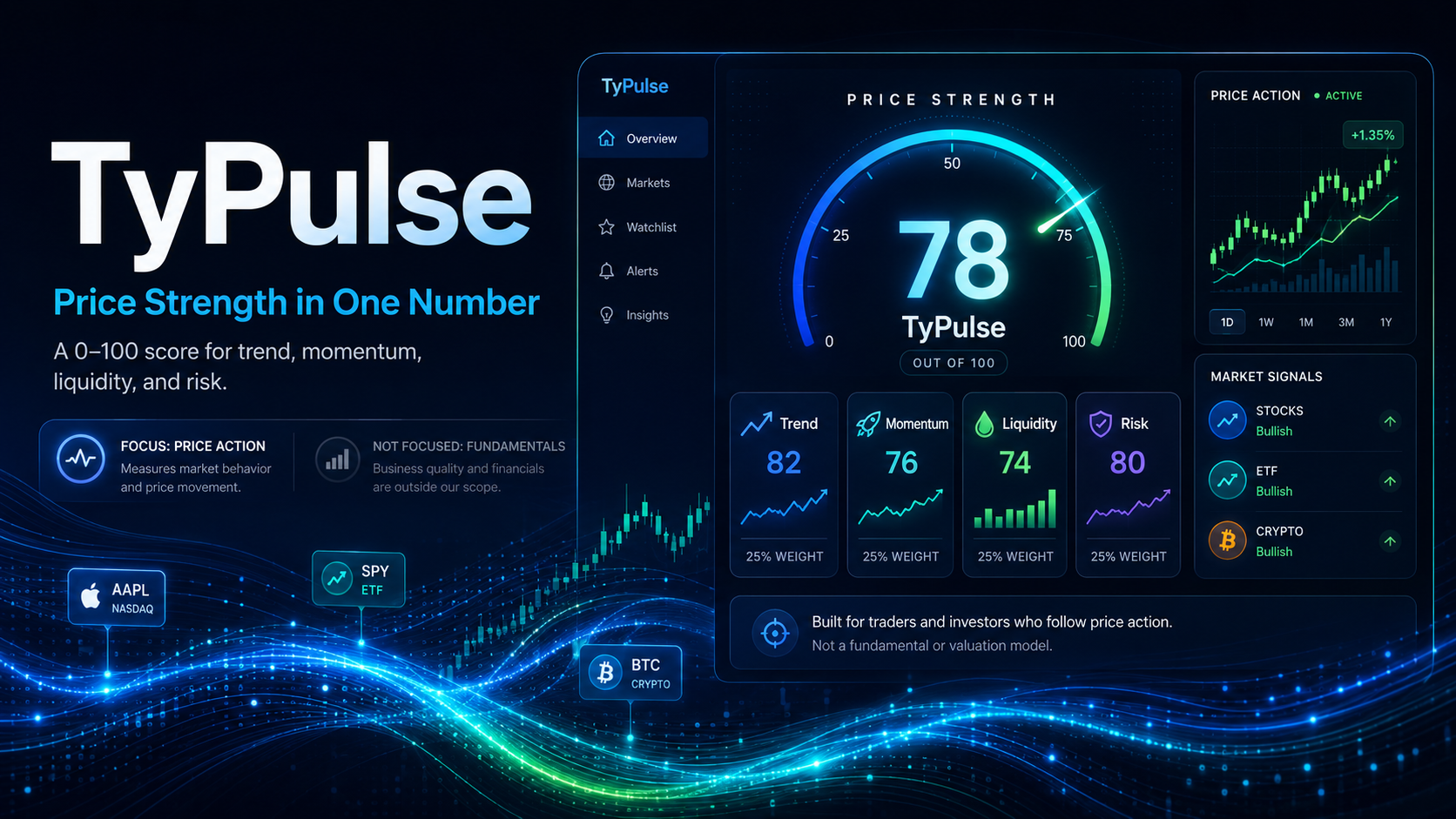
TyPulse is our answer. It's a single number from 0 to 100 that summarises how strong an instrument looks purely from its market behaviour — so you can rank, compare and shortlist by strength in seconds, across every kind of asset.
One number, four pillars
Like TyScore, TyPulse is built from four equally-weighted pillars — but they're about price, not the underlying business:
- Trend — is it trading in the strong part of its own range and pointing the right way, or sliding?
- Momentum — has it actually been gaining ground, over both the last few months and the last year?
- Liquidity — can you get in and out easily, or is it thin and hard to move without shifting the price?
- Risk — how calm or jumpy has its price been? Steadier strength counts for more than a wild ride.
Each pillar contributes a quarter of the score. Strong-and-steady beats strong-and-frantic, and a name that's climbing on multiple time-frames at once scores better than one riding a single short-lived pop.
It works on everything — especially where fundamentals run out
This is the point of TyPulse: it only needs price and volume, which every tradable instrument has. So it speaks the same language across the whole market.
- For crypto and price-only instruments — which have no earnings, no margins, no fundamentals — TyPulse is the headline score. It's the honest read on something that can only be judged by how it trades.
- For stocks and funds, it sits alongside TyScore as a second lens. TyScore tells you the business is sound; TyPulse tells you whether the market currently agrees.
Read together, they're powerful. A high TyScore with a low TyPulse is the classic "quality on sale" setup — a strong business the market is ignoring. A high TyPulse with a thin TyScore is momentum without much underneath it — exciting, and worth a sceptical second look. The most comfortable setups tend to score well on both.
It's a relative score — read it against something
TyPulse isn't an absolute grade; it's a ranking. A score tells you how an instrument stacks up against its peers — its asset type and currency — not against some fixed yardstick.
That has one consequence worth understanding: look at the whole market unfiltered and the average lands around 50 — because the whole market is the yardstick. The signal appears the moment you narrow the view. Filter to a sector, a size band or a slice you care about, and now a TyPulse above 50 means "stronger than the rest of this group," which is exactly the comparison that's useful. Same idea as TyScore's Universal vs vs-Peers reading: the number means more once you've told it what to compare against.
What TyPulse is — and isn't
TyPulse is a read on the present, not a prediction of the future. Price strength is real and worth knowing — markets trend, and strength often persists — but it can also reverse, sometimes sharply. A high score is the market voting confidently today; it is not a promise about tomorrow.
So use it the way you'd use any strong signal: as a filter and a prompt. Strength tells you where the market's attention and conviction are right now. Pair it with TyScore to ask the better question — is this strength backed by something real, or is it just a crowd?
Try it on something you're watching
Pull up a name you think is "hot" and check its TyPulse — does the number agree, or is the strength shallower than the story? Then check something you believe is quietly excellent but overlooked. When a low price-strength score sits next to a high quality score, you may be looking at patience paying off later — and when both light up at once, the market has already noticed what you spotted.
That's the whole idea: TyScore for is it good, TyPulse for is it moving. Two honest numbers, one quick read on where to look next.