Why the next serious investing platform will not be just a chatbot
The current wave of AI investing products has created a useful but uncomfortable question:
If an AI can explain markets, summarize news, read filings, and discuss portfolios, does every investment platform eventually become a chatbot?
Probably not.
At least, not if the goal is serious research.
A chatbot can be useful. It can help explain concepts, summarize information, and organize questions. But investing is not only a language problem. It is also a process problem.
What universe are you analyzing?
Which filters define the opportunity set?
Which model ranks the instruments?
How often does the portfolio rebalance?
How is capital allocated?
What assumptions drive the backtest?
What happens when market conditions change?
Those questions cannot be answered by fluent language alone.
This is why the most important distinction in AI investing is not "AI or no AI." The distinction is whether AI is being used as the investment engine or as the layer that helps users understand a structured investment process.
At TyBuff, the second path is the one that matters.
LLMs are useful, but they are not market oracles
Large language models can be genuinely useful in finance. Academic research suggests that LLMs can extract information from financial news and market text in ways that may contain predictive signal.
For example, Lopez-Lira and Tang study whether GPT-style models can forecast stock-price reactions from news headlines. Chen, Kelly, and Xiu find that LLM-based news signals contain incremental information beyond traditional predictors. More recent surveys of LLM agents in finance also show real potential across investment research, data analysis, risk management, and trading support.
That is the positive side.
The dangerous side is that an LLM can sound confident even when its answer is incomplete, stale, poorly grounded, or wrong. This matters in every domain, but it matters more in finance because a convincing answer can quickly become a capital decision.
Regulators are already focusing on this boundary. FINRA has reminded firms that existing securities rules apply when generative AI and LLMs are used in financial services. The SEC has brought enforcement actions against advisers for misleading claims about AI use. The CFTC has warned retail users that AI trading bots are not money machines and cannot predict sudden market changes.
The lesson is simple:
AI can improve research. It should not remove accountability.
The weak version of AI investing
The weak version of AI investing looks like this:
Ask a model what to buy.
Receive a confident answer.
Accept the explanation because it sounds intelligent.
Forget to check the data, assumptions, methodology, and risks.
This is not discipline. It is outsourcing judgment to language.
The problem is not only hallucination. The deeper problem is that the reasoning path can be unstable. Change the prompt, change the framing, change the input data, or change the model version, and the answer may shift.
That might be acceptable for brainstorming. It is not enough for strategy research.
Investors do not only need an answer. They need a process they can inspect.
The stronger version: AI around a repeatable process
A stronger investment workflow starts before the AI explanation.
It starts with explicit rules.
In TyBuff, the core is not a generic chatbot. The core is the research engine:
- Market Explorer helps users read the broader market and rank securities by structured metrics.
- TyScore provides a proprietary quality-focused lens.
- TyPulse provides a proprietary price-strength lens.
- Strategy Builder lets users define universes, filters, timing, allocation logic, and rebalancing rules.
- Dynamic baskets can be built from Market Explorer rankings and rebalanced according to the defined process.
- Backtests show how that process behaved historically under selected assumptions.
- Intrinsic Value tools add valuation frameworks such as Graham-style and discounted-cash-flow approaches.
- Portfolio tools help users review holdings, scenarios, concentration, and historical behavior.
The AI chat sits around this workflow. It can help users understand settings, discuss results, ask follow-up questions, and identify assumptions.
But the chat is not the strategy.
The process is the strategy.
Why this matters for dynamic portfolios
A static portfolio answers one question:
"What were the holdings?"
A dynamic strategy process asks a more useful set of questions:
"How were the holdings selected?"
"What ranking or filter created the basket?"
"When did the basket rebalance?"
"How did the process react to changing market data?"
"What would the rules have done at each point in time?"
This distinction is central.
If a portfolio is simply chosen after looking at the past, the backtest can become dangerously flattering. It may reflect hindsight bias, survivorship bias, overfitting, or a selected period that makes the idea look cleaner than it really was.
That is why TyBuff's recent blog direction matters. The article "Don't Backtest a Portfolio. Backtest the Process Behind It." captures the right philosophy. The goal is not to test a frozen list of securities that already looks good. The goal is to test the decision process: universe, model, timing, allocation, and rebalance logic.
That is where AI becomes more useful and less dangerous.
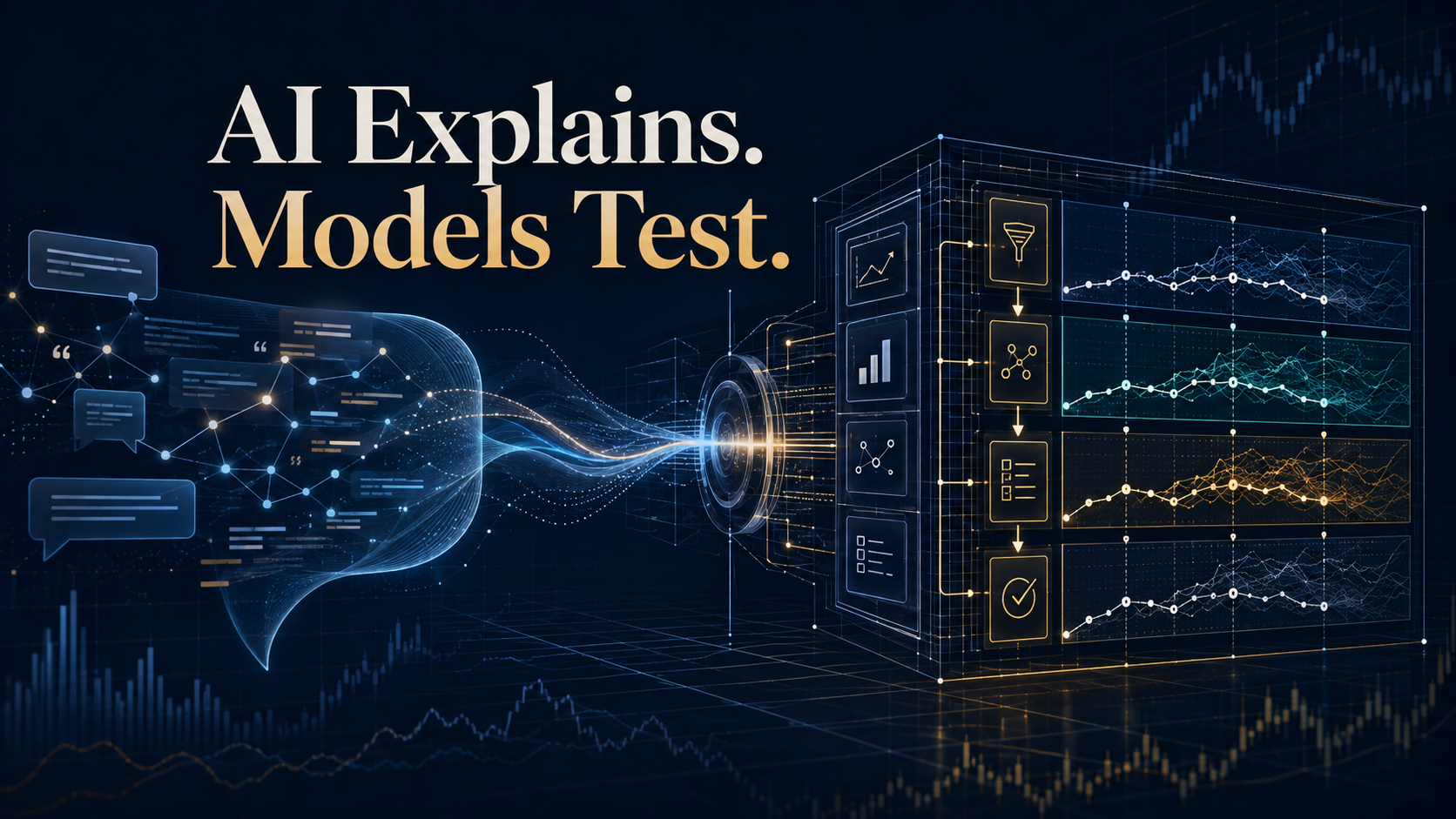
The AI can explain the process. The model tests the process.
What makes TyBuff different from generic AI platforms
Many new AI investing tools are built around a conversation. TyBuff is built around a research workflow.
That difference creates several practical advantages.
First, the user can define the parameters. Instead of accepting a black-box answer, the user can choose the universe, filters, rules, and assumptions.
Second, the output is tied to a model-driven process. TyScore, TyPulse, Market Explorer filters, Strategy Builder logic, and dynamic baskets create structured outputs that can be reviewed and compared.
Third, the backtest is repeatable. A useful backtest is not a marketing chart. It is a documented scenario based on defined rules, data, assumptions, and methodology.
Fourth, the LLM has a healthier role. It explains, clarifies, and supports interpretation. It does not need to pretend it knows the future.
This makes TyBuff more modern, not less modern.
A chat-first product may feel futuristic. But in finance, the more durable architecture is likely to be model-first, data-grounded, auditable, and explainable.
What the large platforms are showing
The large financial platforms are moving quickly.
Schwab has introduced AI-powered portfolio insights for retail clients, focused on explaining portfolio performance, market news, and research context. Schwab explicitly frames the feature as information, not investment advice.
Coinbase Advisor uses LLMs and other AI techniques to generate financial advice, trade recommendations, explanations, and educational content within a registered-adviser structure. Its own disclosures warn that AI outputs may be wrong, incomplete, biased, false, inconsistent, unsuitable, or out of date.
Robinhood's Agentic Trading documentation describes a model where third-party AI agents can connect to a dedicated account and help with investing, including placing orders. The disclosures emphasize that AI agents can make errors, misinterpret instructions, act on incomplete information, and execute trades without direct confirmation if configured that way.
These examples show the direction of the market. AI is moving closer to portfolios, accounts, and execution.
But they also show the risk.
As AI gets closer to capital, the need for structure, review, and user control becomes more important, not less.
The serious investor question
The serious question is not:
"Can AI give me an answer?"
The serious question is:
"Can I understand the process that produced the answer?"
That means asking:
- What data was used?
- Was the universe fixed or dynamic?
- Were the rules defined before the result was known?
- Was the backtest affected by hindsight or survivorship bias?
- Which assumptions drive the result?
- What breaks the strategy?
- How sensitive is the outcome to the rebalance schedule?
- Is the AI explaining a model output or inventing a recommendation?
- Can the user inspect the logic before acting?
This is where TyBuff's positioning is strongest.
The point is not to replace judgment. The point is to make judgment more disciplined.
Analysis, not autopilot
AI in investing is not going away. It should not go away. It can make research faster, more interactive, and easier to understand.
But the best use of AI is not to create the illusion of certainty.
The best use is to help investors structure research, test assumptions, compare scenarios, and understand the behavior of a process.
That is why TyBuff should not be understood as "another AI that tells you what to buy."
TyBuff is better described as:
A strategy-research platform where proprietary models, market filters, dynamic baskets, backtesting, valuation tools, and AI-assisted explanation work together.
LLMs explain.
Models test.
Users decide.
That is the future worth building.
Suggested Internal Links
- Don't Backtest a Portfolio. Backtest the Process Behind It: https://tybuff.ai/blog/dont-backtest-a-portfolio-backtest-the-process-behind-it/
- The AI That Never Learned a Single Stock: https://tybuff.ai/blog/the-ai-that-never-learned-a-single-stock/
- Strategy Builder: A Step-by-Step Guide to Building Back-Tested Portfolios: https://tybuff.ai/blog/strategy-builder-a-step-by-step-guide-to-building-back-tested-portfolios/
- See the Whole Market, Then Build a Strategy That Moves With It: https://tybuff.ai/blog/see-the-whole-market-then-build-a-strategy-that-moves-with-it/
- The Market Explorer, A Step-by-Step Guide: https://tybuff.ai/blog/the-market-explorer-a-step-by-step-guide/
- How to Backtest a Strategy Without Fooling Yourself: https://tybuff.ai/blog/how-to-backtest-a-strategy-without-fooling-yourself/
- What TyScore Actually Measures: https://tybuff.ai/blog/what-tyscore-actually-measures/
- What TyPulse Actually Measures: https://tybuff.ai/blog/what-typulse-actually-measures/
- The Intrinsic Value Calculator, A Step-by-Step Guide: https://tybuff.ai/blog/the-intrinsic-value-calculator-a-step-by-step-guide/
Sources
- TyBuff blog: https://tybuff.ai/blog/
- TyBuff homepage: https://tybuff.ai/
- TyBuff full disclaimer: https://tybuff.ai/full-disclaimer/
- FINRA Regulatory Notice 24-09: https://www.finra.org/rules-guidance/notices/24-09
- SEC AI washing enforcement: https://www.sec.gov/newsroom/press-releases/2024-36
- CFTC AI trading bots advisory: https://www.cftc.gov/LearnAndProtect/AdvisoriesAndArticles/AITradingBots.html
- Coinbase Advisor Terms: https://www.coinbase.com/legal/coinbase-advisor
- Coinbase Advisor Risk Disclosures: https://www.coinbase.com/legal/risk-disclosures/coinbase-advisor
- Robinhood Agentic Trading overview: https://robinhood.com/us/en/support/articles/agentic-trading-overview/
- Charles Schwab AI Portfolio Insights: https://pressroom.aboutschwab.com/press-releases/press-release/2026/Charles-Schwab-Launches-AI-Powered-Capability-That-Helps-Investors-Understand-Portfolio-Performance-and-Market-Activity/default.aspx
- Lopez-Lira and Tang, Can ChatGPT Forecast Stock Price Movements?: https://papers.ssrn.com/sol3/Delivery.cfm/4412788.pdf?abstractid=4412788
- Chen, Kelly, and Xiu, Expected Returns and Large Language Models: https://papers.ssrn.com/sol3/papers.cfm?abstract_id=4416687
- Dong et al., Large Language Model Agents in Finance: https://aclanthology.org/2025.findings-emnlp.972/